
An enterprise AI adoption strategy sets out which work AI should improve, who owns that improvement, and what evidence will justify further investment. For a company with 100 or more employees, it also has to answer a harder question: how will useful practice spread beyond the handful of people who already know what they're doing?
Buying access, training people, sorting out permissions, and supporting teams after launch all belong in that plan. This guide focuses on employees using generative AI in their work, with a practical test at its center: does the finished work improve?
Find the constraint before expanding the program
Rising usage can hide a workflow that has barely improved. Someone might open a tool every day but spend more time checking its output than they save. Another employee might use it twice a month for a demanding report and get considerable value.
For program decisions, separate three questions:
- Access. Can people participate?
- Use. Do they use AI on the work it is meant to help with?
- Improvement. Is the finished result better, faster, or less costly at an acceptable standard?
A rising login count answers only part of that story.
An August 2025 discussion in Reddit's r/sysadmin captures how easily a rollout can get stuck on access. An employee posting as whiterice07 described a large company that had announced Copilot and blocked ChatGPT. The next idea was to change employees' desktops.
My boss is asking about possibly putting a CoPilot shortcut on the task bar, but I hesitate to want to make any changes to the user's desktop experience.
The employee described a fairly large company; its identity and headcount were not stated. This is a self-reported rollout question.
A respondent, lordmycal, urged them to investigate why staff wanted other tools in the first place. That is a useful question for your own rollout. Making a tool easier to open helps with access; understanding why someone reaches for an alternative tells you more about task fit.
Ask a team to walk you through a recent task, including the awkward parts:
- Where did they switch tools?
- Which output did they throw away?
- Who checked it?
- What happened after they finished their part?
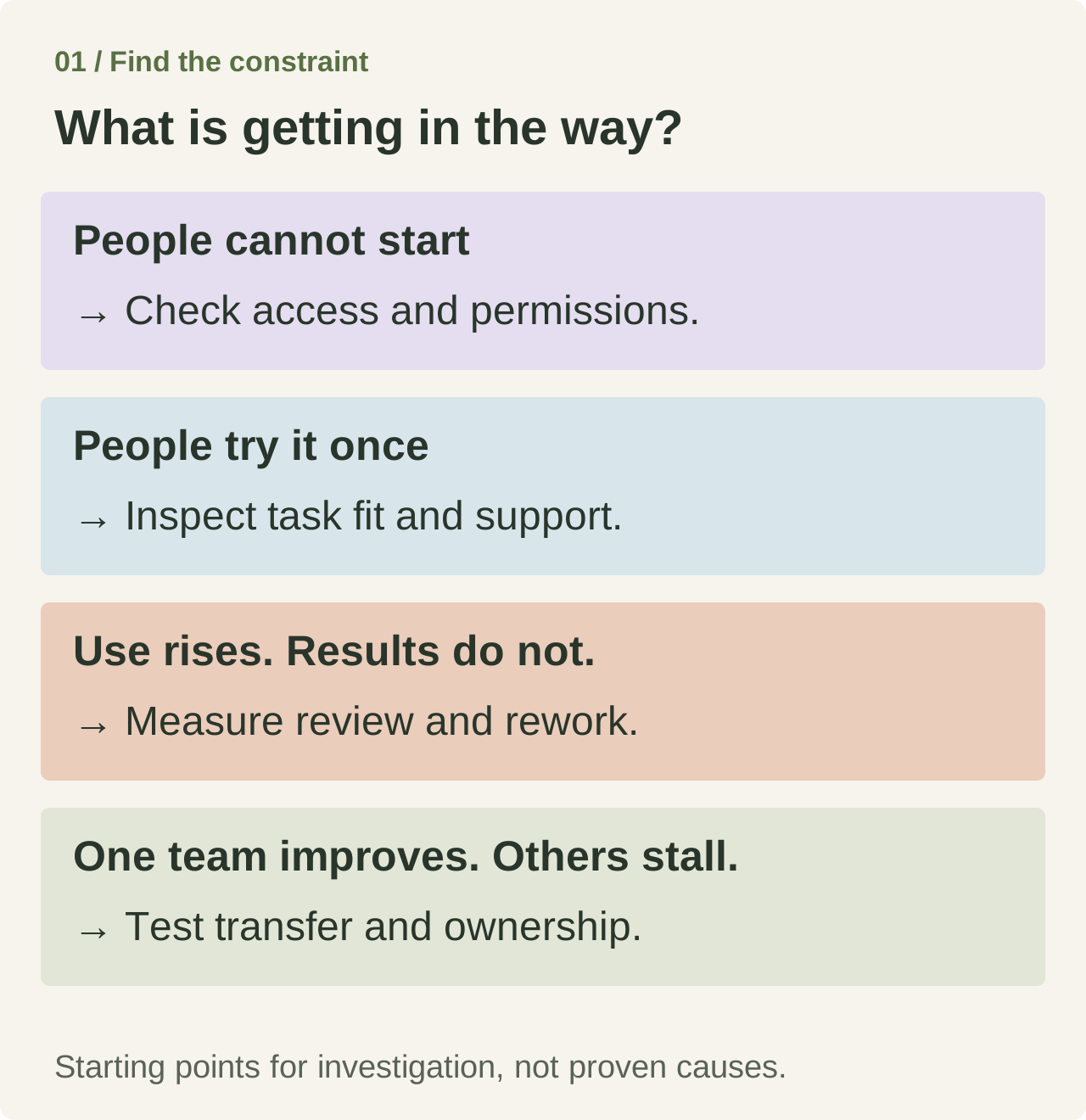
If a team can't access the documents it needs, another prompting workshop won't resolve that dependency. If the output is useful but nobody has permission to change the approval process, the next conversation belongs with the process owner.
This is why a company-wide maturity score is rarely enough to choose your next action. Finance might have a well-supported monthly workflow while sales is still deciding what customer information it can use. Work through the constraint in each setting.
Choose a workflow with a result you can check
Look for a candidate with four practical features:
- A recurring problem. The work has a recognizable cost or delay.
- A checkable result. A subject expert can distinguish an acceptable output from an unacceptable one.
- Approved inputs. The information people need is accessible through approved tools.
- A recovery path. The team knows what to do when the output is wrong.
A useful first candidate might be drafting an internal service handover. The team can compare it with its current handover, check whether commitments and unresolved issues are accurate, and keep a person responsible for approval. An autonomous system making an irreversible decision demands a different level of assurance and operating support.
Before selecting a pilot, write down:
- The work: the task, the people doing it, and how often it happens.
- The current problem: delay, effort, inconsistency, missed information, or another observable issue.
- The acceptance standard: what must be correct, who checks it, and what happens when it fails.
- The proposed change: the part AI assists, the information it uses, and the human decisions that remain.
- The owner: the person who can change the workflow and act on the result.
Microsoft's AI strategy guidance likewise starts with business problems and use cases before selecting technology. Its implementation options are specific to Microsoft's products; the ordering is useful more broadly. Microsoft AI strategy guidance.
Some work is better improved by removing an unnecessary approval, fixing a form, or using a predictable automation. Keep those options in the comparison. A strategy that lets you reject a poor AI use case protects time for a better one.
Give the program an owner and each workflow an owner
The person coordinating AI adoption cannot personally redesign every department's work. They can organize the program, help teams learn, and bring unresolved decisions to the right people. A business owner still needs to take responsibility for each workflow's results.
Executive coach Glenn Gow puts the ownership problem plainly in his LinkedIn newsletter.
A directive without an owner goes nowhere. An owner without a number is just a title.
Gow's advice draws on his coaching work and executive interviews. The quotation is his recommendation, not a measured adoption result.
The number should describe a business result someone can influence. Assigning a login target alone would leave the workflow question unresolved. A practical starting arrangement has these responsibilities:
| Responsibility | The decision this person must be able to make |
|---|---|
Executive sponsor | Which business outcomes matter, what receives funding, and which cross-team obstacles need intervention |
Adoption or enablement lead | How teams get support, how learning is shared, and which issues reach the sponsor |
Workflow owner | What changes in the work, what counts as acceptable performance, and whether to expand or stop |
IT, security, data, and other specialists | Which tools, information, permissions, and controls the workflow requires |
Team manager and champions | How people get time to practise, where they get help, and which problems need escalation |
In a 150-person organization, one person may hold several of these responsibilities. In a larger company, business units may need their own workflow owners and local support. The test is whether decisions get made and support is available, rather than whether the organization chart has a particular title.
Connect local ideas to central support
Give the program a simple operating rhythm:
- Set common boundaries. Agree tool and data-use rules centrally. Let business units choose useful work within them.
- Keep one pilot inventory. Record active pilots, owners, costs, findings, and unresolved dependencies. Look for duplicated work and shared obstacles.
- Review the next decisions with the sponsor. Decide where funding and specialist time should go, including help for teams waiting on the same data connection.
Self Financial offers a concrete example. In an October 2025 interview with Glenn Gow, CEO Julie Szudarek described departmental champions identifying their three biggest AI opportunities. A central AI operations team helped turn those ideas into workflows and train the people using them.
In marketing, that included push notification copy and email subject lines. Gow's account describes an organization of more than 400 employees. The interview's published account.
The useful detail is what happened after a champion raised an idea: someone helped implement it, and the wider team learned how to use it. Build two things into that handoff:
- A route to specialist help. Champions need someone who can help turn an idea into a supported workflow and bring colleagues into the practice.
- An owner for local differences. Instructions, access arrangements, and support that work for English-speaking office staff may need to change for another workforce. Check those assumptions before expanding.
Microsoft's Copilot adoption checklist recommends an executive sponsor, a team spanning business, IT and skilling, and champions who help colleagues use the tool. That is implementation guidance, not evidence for a universal staffing ratio. Microsoft's adoption planning checklist.
Hire for the work the role needs to do
When hiring an adoption lead, ask for examples of how they have:
- Investigated a workflow and found what was holding it back.
- Worked with skeptical colleagues and understood their concerns.
- Designed learning that people could apply to their own tasks.
- Interpreted results and used them to make a decision.
Enthusiasm for AI helps. It doesn't establish those abilities by itself.
Give champions a defined job and time to do it. A colleague who can show how they checked an AI-generated handover is useful to the program. Expecting that colleague to provide unlimited support alongside a full workload is a resourcing decision that deserves to be visible.
Decide what to buy, configure, or build
Make this decision against the workflow you selected. A company can sensibly buy a general assistant for some work and build an integration for another.
| Option | When it fits | What to check |
|---|---|---|
Use an approved product | It can perform the task with suitable data controls. | Compare total effort and output quality with the current process before committing to more implementation work. |
Configure or integrate | The core capability works, but people need company information, reusable instructions, or a connection to the next step. | Include maintenance of those connections. Avoid relying on one person's undocumented setup. |
Build a custom solution | A material requirement remains unmet and the organization can support a custom system. | Name who owns evaluation, permissions, monitoring, changes, support, and retirement. Include their time in the cost. |
Test the current process, an approved product, and the smallest credible alternative on representative work. An impressive demonstration tells you little if its inputs, review effort, or failure cases bear little resemblance to your team's tasks.
Help people practise on the work they actually do
An introductory session can explain the tool and its boundaries. People then need practice with the decisions their own work requires: which information to provide, how to assess the result, and when to leave AI out of the task.
For the renewal-brief example, run a session in this order:
- Start with an approved account record. Identify what the brief needs to include and what information is available.
- Produce a draft together. Pair less confident colleagues with someone who can explain their choices.
- Check every commitment against its source. Show the checking process, including an error that matters and how to correct it.
- Try a record with missing information. Show how to leave the gap visible instead of inventing an answer.
- Save a checked example. Keep the brief, its inputs, and useful corrections together. Update it when the workflow or tool changes.
The World Economic Forum's Future of Jobs Report 2025 identifies skills gaps and organizational culture among employers' perceived barriers to transformation. That survey covers broader business change and future expectations, so it doesn't establish why a particular AI rollout has stalled. It does give leaders a reason to investigate capability and working conditions alongside technology. WEF workforce strategies.
Measure the finished work, including review and rework
The evidence for AI productivity is promising in some settings and much less straightforward in others.
In Generative AI at Work, Brynjolfsson, Li and Raymond studied the introduction of an assistant to customer support agents.
15%
more issues resolved per hour, on average
The study tracked 5,172 customer support agents as an AI assistant was introduced. The gains varied substantially across workers.
Less experienced and lower-skilled workers improved more; the most experienced and highest-skilled workers saw small speed gains and small quality declines. The result describes that support setting, so check where your own workflow and employees differ.
METR's July 2025 randomized study found that 16 experienced open-source developers, working on 246 tasks in repositories they knew, took 19% longer when allowed to use early-2025 AI tools.
The researchers explicitly caution against generalizing that result to all software work. In a February 2026 update, they said newer tools likely helped more, but selection effects made the size of the newer productivity estimate unreliable. METR's original study, follow-up and limitations.
These studies measure different work under different conditions. Treat them as reasons to test your workflow and your participants, rather than average their headline numbers into a forecast.
How checking changes the time saved
Suppose 40 employees each prepare two recurring drafts per week.
- Current process. 45 minutes to draft + 15 minutes to check = 60 minutes.
- AI-assisted process. 20 minutes to draft + 20 minutes to check + 5 minutes for rework = 45 minutes.
Both versions must pass the same acceptance standard.
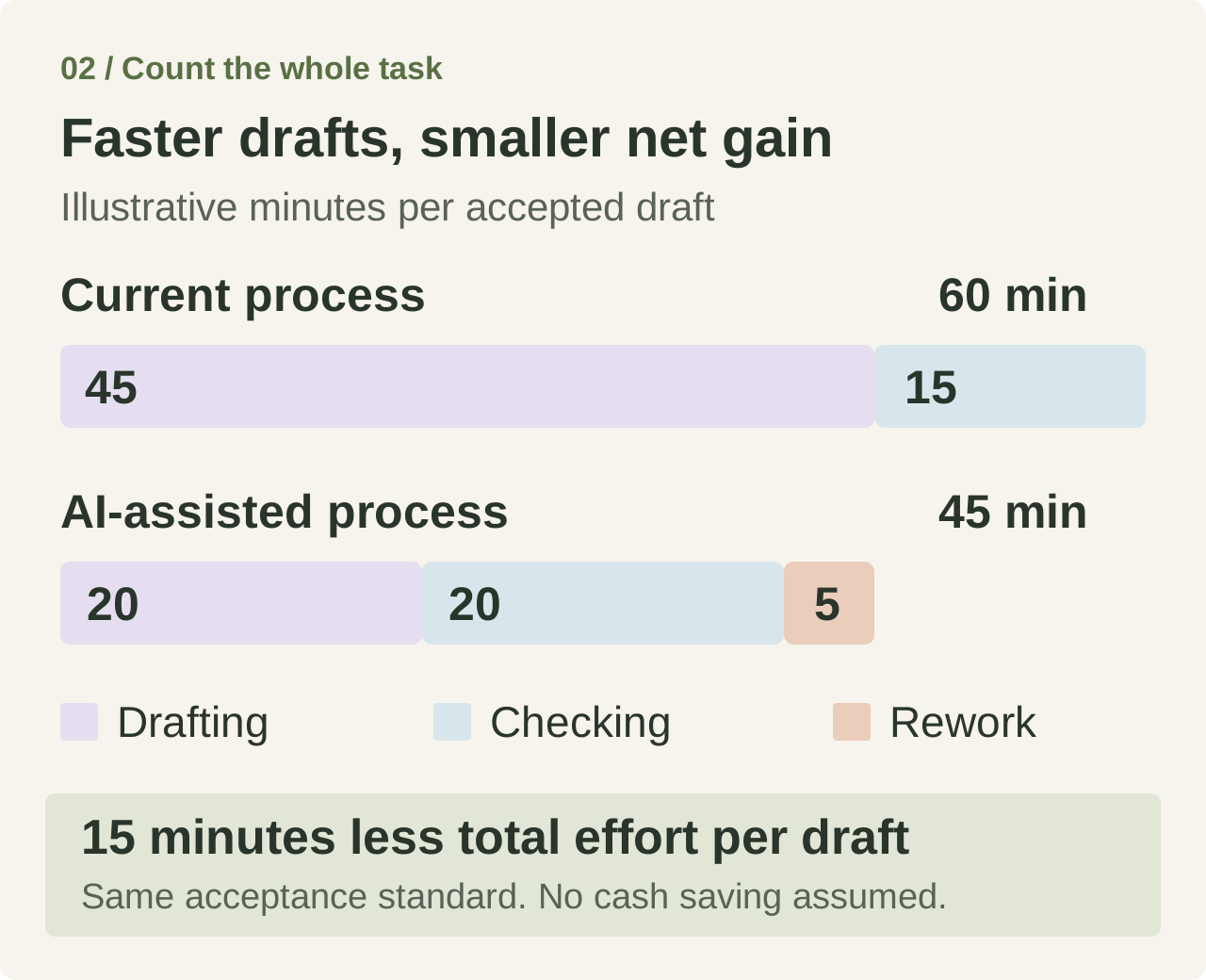
Timing the draft alone would miss the extra review effort. Timing only the person writing it could also miss work transferred to a manager, a specialist, or the next team. Track the whole path to an accepted result, and keep a separate measure of elapsed turnaround time when waiting is the real problem.
Vas, the CEO of AI implementation firm Varick, makes the distinction between effort and waiting in a September 2026 article on X.
The work can be minutes while the process can still be weeks.
From a consultant's account of an unnamed client case in an article about his firm's AI implementation work.
A quick draft can still sit in an approval queue for days. If waiting dominates, a faster draft may barely change delivery time. Measure both human effort and elapsed turnaround time.
Keep a small set of useful pilot measures
| Measure | What to record |
|---|---|
Total human effort | Preparation, drafting, checking, rework, and work passed to other people. |
Elapsed turnaround time | Time from starting the task to an accepted result, including waiting. |
Output quality | Whether the result meets the same acceptance standard as the current process. |
Errors and escalations | Failures that matter, how they were handled, and who had to help. |
Use on eligible tasks | Whether people use AI on the work the pilot is meant to improve. |
Compare similar work and include people with different experience levels. A group made entirely of enthusiasts tells you less about the support the next cohort will need.
McKinsey's March 2025 report found positive correlations between reported financial impact and adoption practices, including tracking defined performance indicators. Its underlying survey was conducted in July 2024. The association supports paying attention to measurement; it doesn't show that installing a dashboard causes a financial return. McKinsey's research and methodology.
Give every pilot an expansion decision
Before the pilot begins, agree on:
- A review point. Allow enough representative work to judge the result. A monthly planning task needs a different observation window from daily support work.
- A decision owner. Name who will decide what happens next.
- Expansion conditions. Set the required benefit and quality standard, manageable exceptions, and a support load the next team can sustain.
- An early pause rule. Decide which serious errors would make it unacceptable to continue until the planned review.
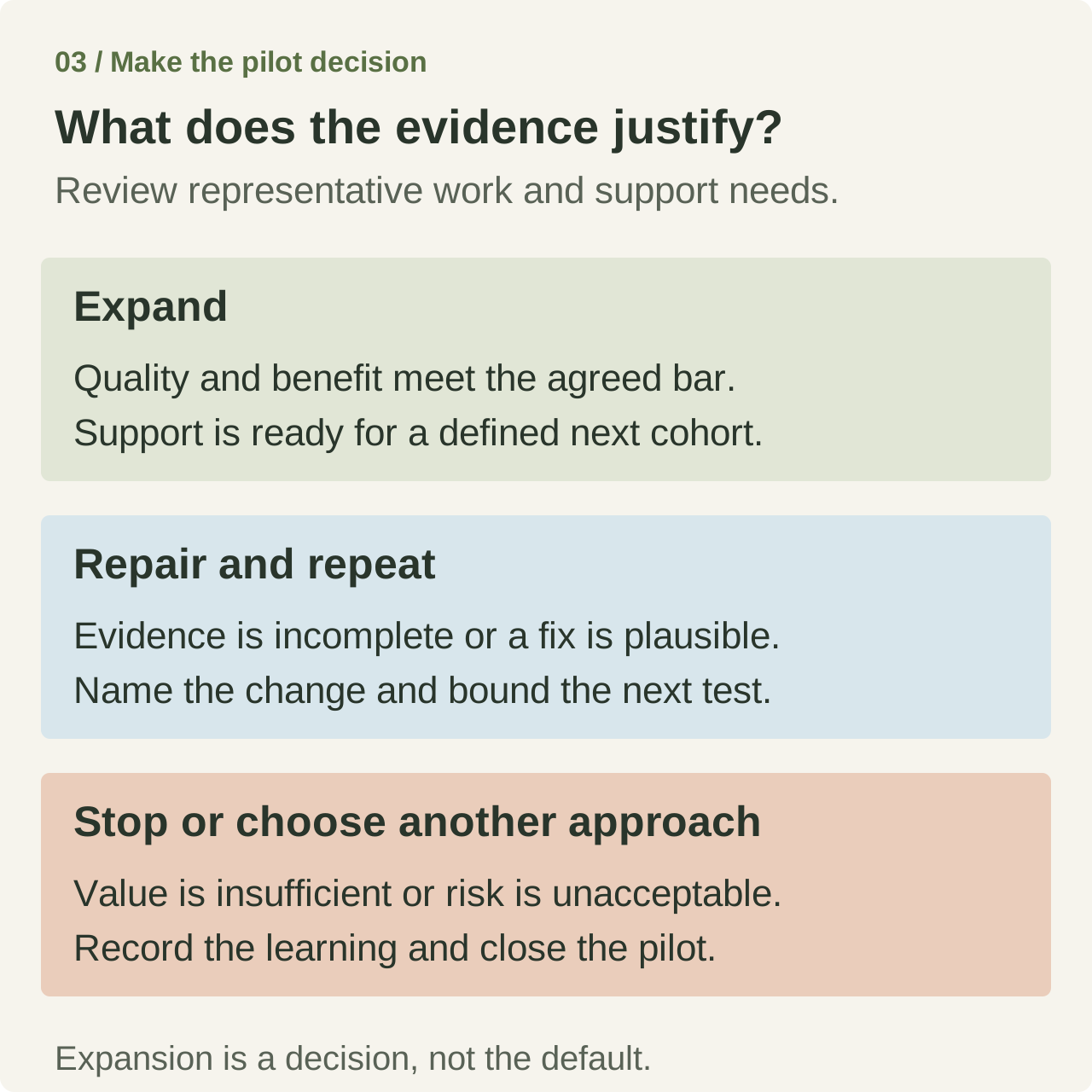
A promising result is permission to test the next scope. It doesn't establish that every department will benefit. Before expanding, check what changes for the next cohort:
- Information access and language.
- Employee experience and task mix.
- Approval requirements and available support.
If the same problem keeps returning, assign an owner to fix it before adding more users. If the benefit remains too small, record what you learned and close the pilot. An experiment can be useful even when the proposed tool doesn't become part of the workflow.
Put the next decision on one page
Bring a workflow owner, someone who does the work, and the adoption lead together. Fill in this short record for one candidate:
If you can't complete a line, you've found a decision the program needs. Resolve it with the people closest to the work. That gives your AI adoption strategy a concrete place to begin.
Questions about enterprise AI adoption
What is an enterprise AI adoption strategy?
An enterprise AI adoption strategy is a plan for improving work with AI across an organization. It connects selected workflows to business goals, assigns owners, gives employees suitable tools and support, and sets the evidence needed to expand. Buying licenses and running training sessions are activities within that plan.
How are enterprises adopting AI?
Enterprises use different arrangements for selecting tools, supporting employees and changing workflows. Self Financial offers one example: in the published account of Julie Szudarek's interview, departmental champions identify opportunities and a central AI operations team helps implement them and train colleagues. The useful pattern is a clear path from a team's idea to supported practice.
Who should lead an AI adoption program?
Choose a lead who can investigate workflows, coordinate business and technical teams, help colleagues learn, and interpret results. Give them an executive sponsor who can resolve funding and cross-team decisions. Each workflow also needs a business owner with authority to change the work and act on the findings.
How do you get employees to use AI more?
Start with a task employees want help with and check that the approved tool can handle it. Give people time to practise on real work, examples of how to check results, and someone to ask for help. When use drops, investigate task fit, access and review effort with the team before prescribing more training.
How do you measure the value of AI adoption?
Compare similar work before and during a pilot, using the same acceptance standard. Count all human effort, including preparation, checking and rework, alongside errors and the business outcome. Measure elapsed turnaround time separately when waiting matters. Treat time released as capacity; establish how it is used before calling it a financial saving.
Should a company buy AI tools or build its own?
Test approved tools you already have against a defined workflow first. Configure or integrate a product when its core capability works but needs company context or connections. Consider a custom build when a material requirement remains unmet and the company can fund ongoing evaluation, permissions, monitoring and support. Include those costs in the comparison.