


Preserve expert judgment by keeping experienced people connected to the decisions their job still requires and the consequences of those decisions. When AI takes over routine preparation, decide which parts can disappear and which still provide useful practice. Then make room for that practice in the workload.
An experienced employee does not need to repeat every old task to remain capable. They do need a way to discover when a familiar explanation no longer fits. That becomes harder if they see only the assistant's recommendation, approve it, and never hear what happened next.
Decide which judgment still belongs in the role
Start with the work that will remain someone's responsibility after automation. “Keep our experts sharp” is too broad to guide an assignment. “Our maintenance planners must recognize when a repeat visit needs a different investigation” gives a manager something to preserve.
Look at a recent case with the person who handled it. Identify the choice that mattered, the information that changed their mind and how they eventually learned whether the choice was useful. Then separate that reasoning from the clerical work around it.
| Part of the work | A reasonable allocation | What to preserve |
|---|---|---|
Copying visit dates into a standard report | Automate preparation | Access to the original records when dates conflict |
Deciding why a recurring problem needs a different visit | Retain selected cases for the planner to investigate | An initial explanation, missing evidence and a proposed next step |
Repeating a procedure the company no longer uses | Replace the practice | Experience with the current procedure and its limitations |
Learning what the contractor actually found | Repair the feedback route | Findings that can confirm or overturn the planner's explanation |
This is a work-design decision. A task may be tedious and still expose important clues. Another may be difficult but no longer useful. Preserve the contact with the problem that the future role needs, rather than the old task merely because it used to take time.
The wider people-and-change guide places this decision alongside workload, support and role changes. Here, the narrower question is how an established expert continues learning from the work.
Keep expertise open to correction
In their 2009 analysis of intuitive expertise, Daniel Kahneman and Gary Klein argue that trustworthy intuition depends on a sufficiently regular environment and opportunities to learn its patterns through practice and clear feedback. Confidence alone does not establish accuracy. Their account also allows expertise to be strong on one task and weak on another.
That gives managers a useful question: does the redesigned job still let the expert encounter meaningful clues and learn what followed? It also sets a limit. Repeating judgments with ambiguous outcomes may reinforce a confident story without showing that the story is right. This research predates generative AI; it does not prescribe a proven maintenance schedule for AI-assisted work.
Expertise can also make a familiar approach hard to question. In a 2025 research synthesis about document-based knowledge work, Alexa Siu and Raymond Fok describe experts wanting to delegate information gathering while retaining interpretation. Their discussion raises the risk of established mental models becoming too rigid and proposes support for alternative perspectives. Long-term retention and transfer remain research questions.
The practical aim is therefore continuing contact with changing conditions. A discussion in which the most experienced person explains last year's answer, and everyone agrees, is a weak substitute for finding out whether that answer still fits this year's work.
Let a real case change the expert's explanation
Suppose Claire Bennett plans contractor visits for a commercial property company. A tenant reports that a meeting room becomes uncomfortably warm each afternoon. An approved assistant gathers previous visit notes and drafts the next visit plan. Claire used to read those notes herself. Now she mostly reviews the proposed plan.
For selected repeat cases, Claire's manager retains a short investigation before the assistant's recommendation is shown. Claire reads the permitted source records and states what she thinks the next visit needs to establish. She can still use ordinary reference materials. The point is to form a view of this case, not pass a memory test.
The complaint initially looks like a repeat of a previously reported control fault. But the tenant has turned the small meeting room into a daily training room, and contractors can now enter only in the morning. Claire needs to ask how the visit will investigate an afternoon complaint under those conditions. Simply approving the previous visit plan would not reveal whether she noticed the changes.
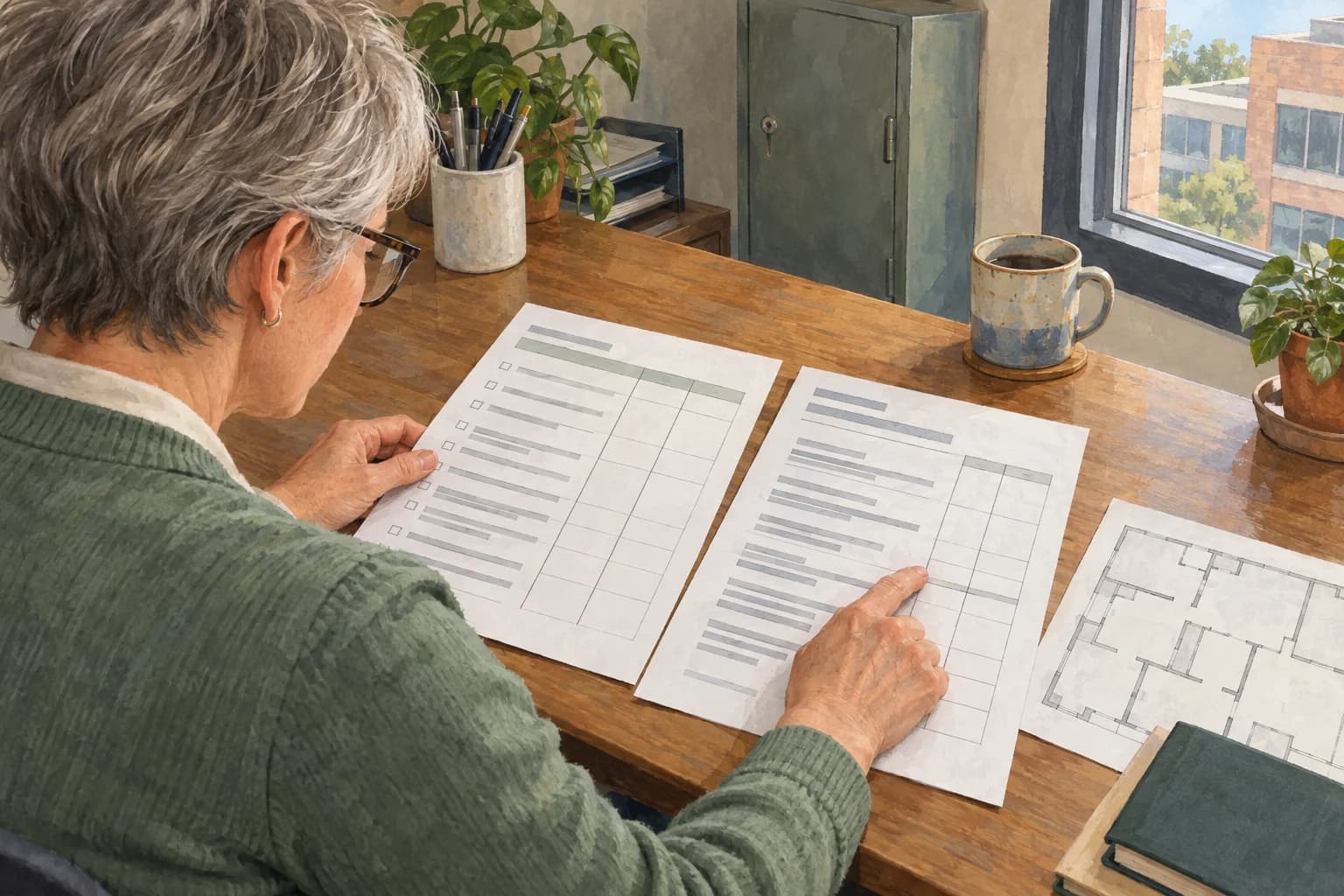
After the visit, the contractor's findings return to Claire. She compares them with what she expected. Perhaps the contractor found something different, could not gain access, or still lacks enough evidence. Those are different outcomes. “Visit completed” would conceal the distinction.
Keep the follow-up focused on a few questions:
- What did we expect to find? Retain the initial view so a later explanation does not silently replace it.
- What actually became known? Separate an observed finding from a missing check or an unresolved report.
- What should change next time? Update the relevant assumption, request better evidence or acknowledge that the cause remains uncertain.
Claire can compare her reasoning with the assistant's alternative after forming her own view. Neither answer becomes correct simply because it came from the expert or the tool. The source records and subsequent findings carry the comparison.
Budget the practice inside normal work
Advice to “do some work yourself” fails if every assignment assumes the fastest assisted completion. Someone has to decide which cases deserve investigation and allow time for it.
In a June 2026 Reddit discussion, a self-described developer at a company with about 200 developers worried that reviewing AI-written changes was replacing implementation practice. In a reply, the developer said management no longer budgeted the time needed to understand the work. The concern was not a shortage of advice to practise; it was the cost of practising against delivery expectations.
Another Reddit user in that discussion described continuing to code while using AI to unblock questions and refresh knowledge. Their clarification matters: the employer had not mandated AI use or expected a multiple of the previous output. These are unverified personal accounts, but their contrasting conditions make a useful management point. What gets delegated and what the workload rewards both matter.
For Claire's manager, the agreement needs practical choices:
- Allocate the work. Reserve relevant repeat cases for investigation, include the return of findings and identify what other work will move or become lighter.
- Vary the conditions. Choose cases that can challenge an assumption. Giving Claire only the same familiar example leaves changed conditions unexplored.
- Choose a safe setting. If live work cannot provide a suitable opportunity safely, use a permitted historical case with its outcome initially withheld. Keep normal review and approval requirements for real decisions.
Adding practice on top of an unchanged queue makes the agreement difficult to sustain. The manager needs to account for the work, not leave Claire to fit it around delivery.
There is a cost to preserving this capability. Compare that cost with the work quality and responsibilities the company needs to retain. The AI value measurement guide explains why time saved needs to be considered alongside quality and the cost of checking and correction.
Check the work before diagnosing skill loss
Less typing, slower recall and lower confidence can prompt a conversation. They do not, by themselves, demonstrate declining judgment. The role may have changed, a reference may be harder to find, or a new case may require knowledge the person has not yet acquired.
Review the specific decision before prescribing more repetition:
- If the expert still identifies the important clues but cannot get the later findings, repair feedback.
- If the old explanation fails under a changed procedure, provide practice with the new conditions.
- If the person can approve a recommendation but cannot investigate a comparable case, retain opportunities to generate and test a view.
- If the required decision has moved out of the role, reconsider whether maintaining that old capability is still the right investment.
These observations guide work allocation. A formal claim about an employee's capability needs a more deliberate assessment, including clear conditions and comparable tasks. The AI proficiency guide covers that separate decision.
Begin with one expert decision whose practice or feedback is about to disappear. Agree what will replace that opportunity, who will make room for it and what evidence will tell you to revise the arrangement. That is a concrete responsibility a manager can carry into the next change to the workflow.
Questions about maintaining expert judgment
Must experts keep doing every routine task manually?
No. Maintain the parts of the work that exercise judgment the role still needs. Automating the preparation of a visit report can be sensible while retaining selected investigations and access to original records. Use the work-allocation comparison to separate preparation, diagnosis, obsolete procedures and feedback before deciding what stays manual.
How often should experienced staff practise independently?
There is no universal frequency established by the evidence discussed here for preserving judgment in AI-assisted jobs. Choose opportunities according to the decisions people must still make, how often conditions change and whether useful cases occur naturally. Start with a bounded arrangement, make time for it and revise it using observed work. Avoid treating a weekly exercise as proof that expertise has been maintained.
Does reviewing AI output count as expert practice?
Review can exercise expertise when the reviewer investigates assumptions, checks sources and tests consequences. It may provide less practice in generating an explanation or building a solution from the beginning. Decide which capability the future role requires, then inspect what the review actually involves. In the maintenance-planning example, forming an initial view and reading the returned findings add opportunities that approving a draft alone would miss.
What if the outcome arrives much later?
Keep the initial reasoning and assign responsibility for returning the outcome when it becomes available. Record uncertainty if later events cannot distinguish between explanations. A delay or unclear result limits what the case can teach; agreement with an AI response does not fill that gap. The case follow-up questions help keep expectations, findings and the next change separate.
Is maintaining experts the same as developing juniors?
They overlap, but the work allocation differs. Experienced staff need opportunities to keep current judgment in use and revise assumptions. Juniors also need a progression of assignments through which they acquire that judgment in the first place. The apprenticeship guide explains how to protect that progression when AI changes the entry-level work.