


Consider an AI agent when a useful part of the work requires choosing the next step from what the system discovers, and a bounded trial shows that delegating those choices improves the accepted result or reduces the total work. Keep assistance or a fixed workflow when they meet the need. More steps, messy documents and an impressive demonstration do not by themselves justify more autonomy.
For an operations lead and technical owner, the decision is specific: which choice would software take over from a person, with what information and authority? Moving from assistant to agent is not an inevitable next stage of adoption.
In a comment under Marcela Souza's article on agentic design, Yura Danilov described setting up agents for support and sales at Kvitok24. He identified deciding when the agent should act and when it should hand work to a person as a difficult question. That is a practitioner's account, with no verified company-wide outcome, but it puts the operating decision ahead of the label.
Name the decision you would delegate
Start with a recent case that required a person to choose what to do next. Ask them to show the information available at that point and explain why they took that route. Then compare a case where the next step was different.
A person using an assistant might request a draft, check it and decide which record to inspect next. A fixed workflow might extract the same fields and run the same prescribed checks on every request. An agent can choose further steps or tools based on intermediate results, within the authority the system gives it.
Anthropic's engineering guide distinguishes predefined workflow paths from model-directed processes and recommends adding complexity only where it improves outcomes. The guide dates from December 2024 and now flags changes to its tooling discussion. The useful principle here is the choice to test, not a recommendation for a current framework.
Write the proposed delegation in terms someone can dispute. “Investigate which equipment information is still needed before preparing this event plan” is a candidate. “Handle events intelligently” does not tell the team what authority or benefit it would be testing. The tools-and-workflows guide provides the broader comparison of operating arrangements.
Check whether the route really needs to vary
Some apparent agent use cases need a clearer process or a better connection to existing information. Look for those explanations before assigning the model more decisions.
- Varied wording, stable checks. If customers describe requests differently but the required fields and checks stay the same, extraction inside a fixed route may be enough.
- Known exceptions. A missing booking identifier or an unavailable item can follow an explicit branch. A branch does not automatically require an agent.
- A changing investigation. If one finding determines which source to consult next, the useful trial may be whether software can conduct that limited investigation with less intervention.
- An unsettled business decision. If colleagues disagree about what should be allowed, an agent cannot supply the missing authority. Resolve the rule with its owner.
OpenAI's practical guide identifies difficult decisions, unwieldy rules and unstructured information as candidate situations, while allowing that a deterministic solution may suffice. These are vendor design considerations, not proof that every document-heavy process needs an agent.
A useful question is: what would the fixed route have to do badly, or what costly human choice would remain, for delegation to be worth testing? If the answer is only “agents are more advanced,” keep investigating the work.
Compare the same event request three ways
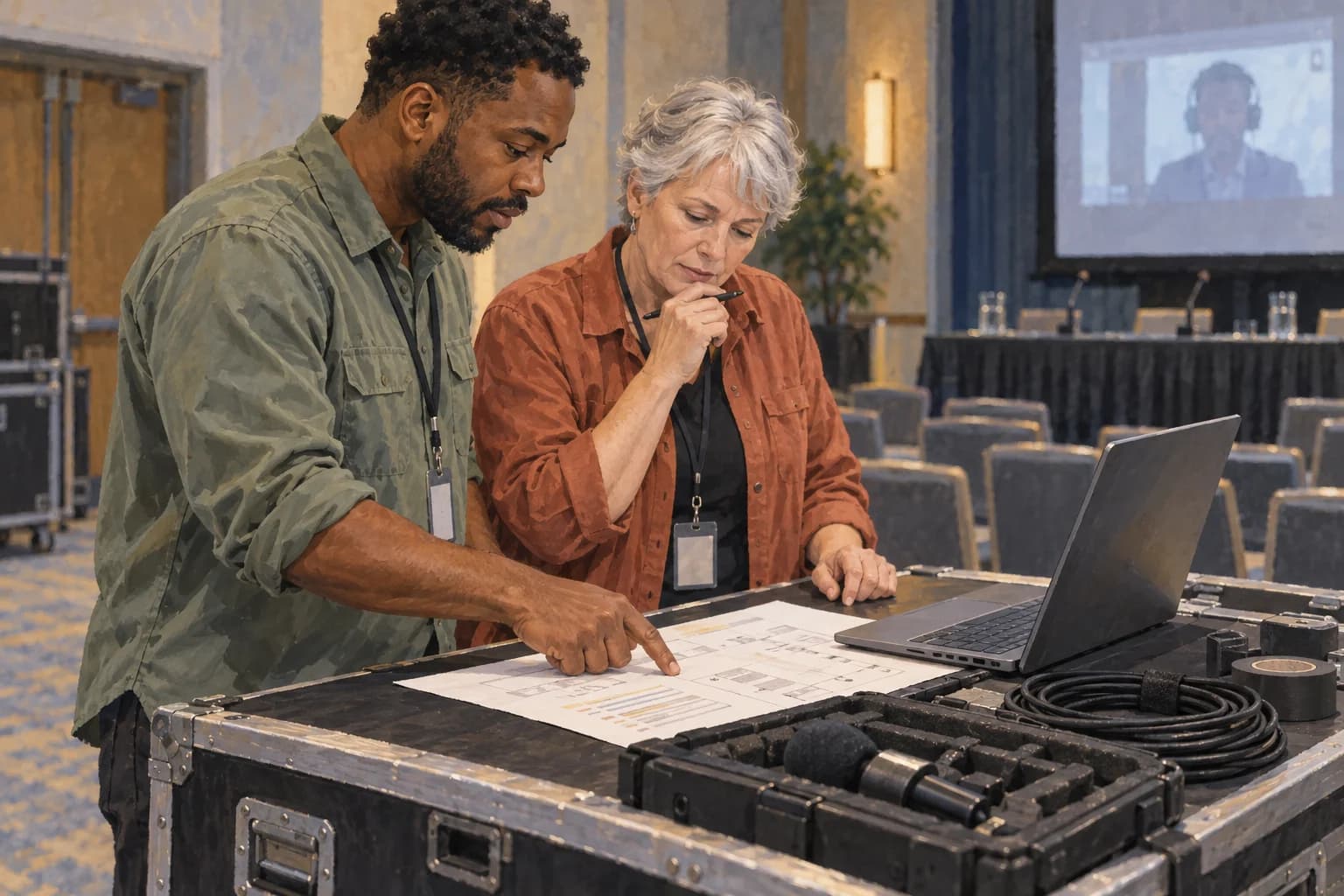
Suppose Alex Morgan coordinates audiovisual equipment for a conference centre. A client moves an afternoon panel to another booked room and adds a remote speaker. Alex needs a proposed equipment plan that a technician can check against the approved agenda, room setup and existing equipment reservations.
The accepted result identifies the relevant room and event, equipment needs supported by those records, and any conflict or missing information. It does not reserve equipment, promise a setup to the client or authorize a purchase. Those decisions remain with the existing responsible people.
Some requests may follow a stable route: extract the event and room, retrieve their records, check the equipment list and prepare a proposal. A fixed workflow could handle those steps. Other requests might reveal information that changes the investigation, such as an existing equipment reservation that refers to a separate event revision. That is a possible place to test bounded next-step selection, rather than handing over the whole event operation.
| Candidate route | What it would do for Alex | Question the comparison must answer |
|---|---|---|
Keep the assistant | Alex selects the records, requests a proposal and decides each further lookup | Does the draft save enough work once Alex's searching and checking are included? |
Use a fixed workflow | Prescribed extraction and record checks prepare a proposal, returning exceptions to Alex | Can the known branches cover the requests without excessive maintenance or manual rescue? |
Trial bounded agent investigation | The system chooses among permitted lookups, then returns a proposal with evidence and unresolved issues | Does choosing those lookups improve the result or reduce intervention enough to justify the added behavior? |
Use equivalent approved cases and the same definition of an acceptable proposal. Do not compare a person's fully checked plan with an agent's unchecked first draft. Record when someone supplies an extra hint or silently repairs a result; that work is part of the arrangement being tested.
Keep the investigation separate from permission to act
An agent can investigate without being allowed to commit the proposed result. Alex's trial can stop at an equipment proposal even if the software could technically edit the booking system. A capability in the product is not a reason to include it in this trial.
Before testing, make the limits concrete:
- Permitted information. Identify the approved agenda, room and reservation records the trial may read.
- Permitted output. Return a proposed plan, its supporting records and unresolved conflicts.
- Stopping conditions. Return missing authority, conflicting records, unavailable tools or an exhausted investigation limit to a named person.
- Accountability. Name who accepts the plan and who can pause the trial when its behavior is unsuitable.
The technical owner needs to demonstrate those boundaries in the running system. Instructions alone do not establish that an unavailable action cannot be performed. For the wider process and receiving person's responsibilities, use the workflow-redesign guide.
Missing information deserves particular attention. In a public Reddit discussion about a business agent, the poster described one communication channel lacking the history of another. Replies challenged whether the failure was specific to agents, and the poster confirmed the histories were separate. This is an unverified account, but the diagnostic distinction matters: more autonomy does not repair information that the system cannot obtain.
There are also practitioners using agents within selected boundaries. In an October 2026 account of Runlayer's software workflow, founding engineer Rafal Wilinski described treating small code changes differently from work near sensitive paths. After a reader questioned indirect dependencies, he clarified that some paths require code-owner signoff. His supplier-affiliated report is not evidence that another company should automate merging. It illustrates why the exact delegated scope and retained decision matter more than a general autonomy label.
Decide what the trial has earned
Agree the comparison before reviewing an attractive result. The credible-pilot guide covers the wider experimental design; this decision needs particular attention to the choices being delegated.
For each approved case, retain a compact record:
- Accepted result. Did the proposal preserve the correct event, sources, requirements and unresolved conflicts?
- Delegated choices. Which next steps did the system choose, and what finding justified each one?
- Human work. Include preparation, searching, hints, checking, correction and recovery.
- Operating burden. Include tool usage, waiting, exception handling and work needed to maintain the route.
- Boundary behavior. Did the system stop and return control when it should, with enough information for someone to continue?
A trial can justify keeping the assistant. It can also reveal that a fixed route handles the useful cases while people retain the unusual investigation. Neither outcome is a failed adoption program.
For Alex, a bounded investigation is worth continuing only if it improves the accepted equipment proposal or the total work compared with those alternatives, while respecting the agreed limits. If staff must repeatedly redirect its searches, reconstruct its sources or undo unintended changes, inspect that burden before expanding its authority.
Questions about moving from assistant to agent
Does a multi-step task require an AI agent?
No. Several model calls or system checks can follow a predefined route. Consider agent behavior when intermediate findings genuinely change which step or tool should come next, and test whether delegating that choice helps. Start by comparing two actual cases with different next steps. The event-request comparison shows how to hold the accepted outcome steady while testing different routes.
Does messy or unstructured input mean we need an agent?
No. Varied emails or documents may need interpretation without requiring software to choose the process. A fixed workflow can use AI to extract information, then run known checks and return exceptions to a person. Identify what remains difficult after that arrangement has been tested. Use the route-variation checks to distinguish input complexity from a reason to delegate further decisions.
Can an AI agent still require human approval?
Yes. Delegating an investigation does not require delegating every resulting action. An agent may gather permitted information and prepare a proposal while a responsible person retains the decision to commit it. Define the exact permitted scope and demonstrate that the running system respects it. The event trial's boundaries keep equipment reservations and customer commitments outside the proposed investigation.
What evidence would justify keeping the assistant?
Keep the assistant when the accepted result and total effort compare favorably with the alternatives, or when the agent's added behavior cannot be bounded and supported adequately. Include the person's search, review and correction work in that comparison, along with the agent route's intervention and operating burden. Record the reason and the condition that would justify reconsideration. The trial record makes this a decision about actual work rather than a tool label.