


Discuss AI's environmental footprint by naming the work, the physical resources involved and the limits of the evidence you have. Explain whether a figure covers model training, day-to-day use, shared infrastructure or equipment manufacture. Keep electricity, emissions and water distinct, and say whose activity was measured. A precise number with the wrong boundary can give a less truthful answer than an explicit unknown.
For an enterprise adoption leader, this is a way to prepare a useful explanation before making a wider commitment. It is not necessary to invent a company footprint from public prompt statistics. You can establish what the proposed use does, which information is available and who will resolve the remaining questions. The tools and workflows guide connects that explanation to choosing work the organization can responsibly support.
Explain the physical work behind the interface
The visible action might be asking for a paragraph or uploading a report. The supporting activity has a longer history and a wider boundary.
Training develops a model from data. Inference uses a trained model to produce an answer or another output. An employee's request does not ordinarily retrain the whole underlying model, but neither does that make its use resource-free. There is also equipment to manufacture and replace, infrastructure to operate, and network and device activity between the service and its user.
Those categories can appear in different parts of an assessment. A supplier might allocate some equipment-manufacturing impact to its service, while leaving the employee's computer outside the calculation. A training estimate and an inference estimate may describe separate activities, or a broader lifecycle figure may already include both. Ask what has been included before adding numbers together.
A useful first explanation answers four questions:
- Which work? Name the actual activity, such as reviewing monthly building reports, rather than “the company's AI.”
- Which boundary? Identify the included stages, infrastructure and equipment, together with material exclusions.
- Which evidence? Distinguish a supplier's measurements, a modelled estimate and your own activity records.
- Which decision? State what this information can support and what remains unresolved.
These questions help an adoption sponsor work with sustainability, IT and procurement colleagues. They do not replace the company's environmental accounting or an assessment of a supplier's full value chain.
Keep electricity, emissions and water separate
“AI uses energy” and “AI has a carbon footprint” describe related questions, not interchangeable measurements. A lower electricity figure does not, on its own, establish the same reduction in every environmental impact.
| Measure | What the unit tells you | Context needed before using it |
|---|---|---|
Electricity, in Wh or kWh | Electrical energy used within a stated boundary | The workload, included equipment, period and whether the figure was measured or estimated |
Greenhouse gas emissions, in CO₂e | Different greenhouse gases expressed on a common warming-impact basis | Included lifecycle stages, electricity assumptions and the accounting method |
Water, in litres or another volume | A quantity of water within a stated boundary | Whether it means withdrawal or consumption, where it occurs and which activities are included |
A watt-hour is a small unit of electrical energy; a kilowatt-hour is 1,000 watt-hours. Neither is a direct measure of water or greenhouse gases. Water withdrawal and consumption also answer different questions: water taken into a system is not necessarily all consumed by it.
The BSR environmental-impact FAQ identifies water demands across activities including material extraction, chip manufacture, electricity generation and data-center cooling. A cooling-only figure therefore cannot answer every water question. The location matters too, particularly when the concern is pressure on a specific water basin.
Carbon, electricity and water are not an exhaustive list of environmental effects. Equipment and infrastructure can also raise material, land and community questions. Keep the explanation proportionate to the decision, but do not describe one available measure as the whole footprint.
Read a prompt statistic with its exclusions attached
A disclosed prompt estimate can be useful evidence about its original service and period. Problems arise when it becomes a universal conversion factor for a different company's work.
Google's August 2025 study reported 0.24 Wh for the median Gemini Apps text prompt in May 2025. Keep three conditions attached to that finding:
- Included activity. The serving-energy boundary covered active computing, host equipment, idle capacity and data-center overhead.
- Excluded activity. It left out training, data storage, external network energy and end-user devices.
- Interpretation. Carbon and water calculations used additional assumptions and fleet averages. The supplier disclosure states that the claims had not been independently verified by a third party.
Those qualifications are part of the finding. The figure is neither a current guarantee for every text request nor a measure of your department's long document reviews, image generation or repeated automated work. Multiplying a median prompt value by a request count does not establish a measured departmental total.
A different boundary can produce a different-looking result without establishing a better or worse supplier. Mistral's July 2025 lifecycle disclosure included upstream equipment-manufacturing impacts, acknowledged approximations in the hardware inventory, and excluded user devices from its stated response estimate. Read the method before putting unlike disclosures into a ranking.
The same care applies at the other end of the scale. The IEA's 2026 energy and AI report distinguishes data centers as a whole from AI-focused activity. It also considers improving task efficiency alongside expanding use and more demanding applications. A global data-center total is not all attributable to AI, and a more efficient individual task does not establish that total demand is falling.
Give one proposed use an honest explanation
Suppose Jamie Lee works in the facilities team of a property-management company. Jamie prepares an investigation list from four office buildings' monthly electricity reports and opening-hours notes. Facilities engineer Alex Morgan checks the building identifiers, periods and units, then decides which apparent anomalies need an on-site inspection.
The company is considering an approved AI tool to help prepare the list. Keep three questions separate:
- Work result. Can Jamie produce a useful list with less correction effort?
- Resource use. What resources does the AI-assisted route use?
- Environmental outcome. Does Alex's subsequent investigation lead to a building change that reduces electricity consumption?
A good result on the first question would not answer the other two.
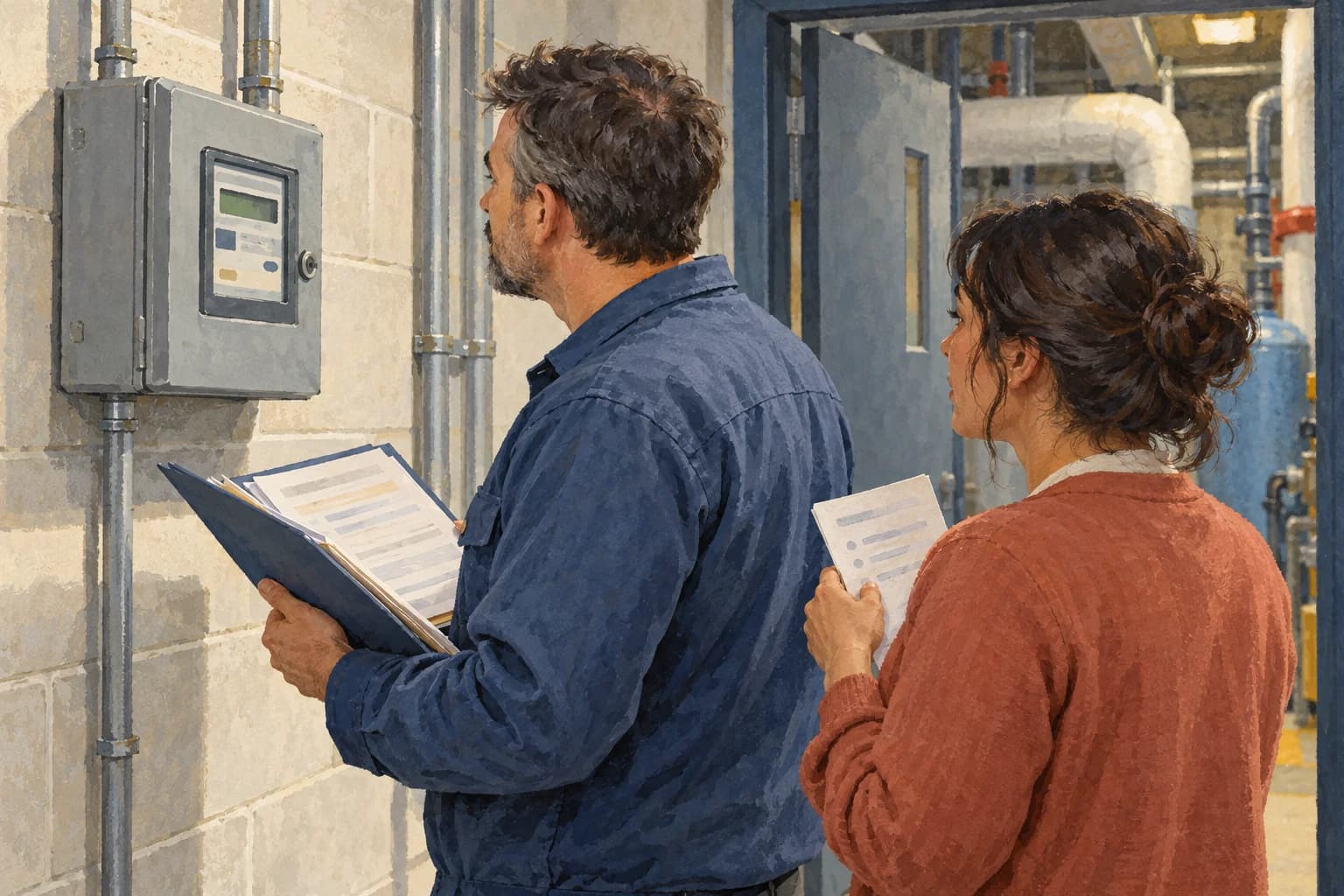
Jamie can record the reports used, the accepted investigation list and the corrections Alex required. Those are useful local work records. They are not a meter reading for the remote AI service.
The technical and sustainability owners can ask whether the supplier has relevant service-level information, what it covers and whether it can be attributed to this use. If only a public benchmark is available, describe it as background evidence. Keep missing geography, allocation or lifecycle information visible rather than filling the gaps with an attractive point estimate.
Alex's building investigation needs its own evidence. A change in a monthly bill might reflect opening hours, weather, occupancy or a maintenance intervention. Do not credit AI with an avoided environmental impact merely because it helped prepare the document that preceded the investigation.
A defensible internal explanation could read as follows.
That statement gives the sponsor something concrete to investigate. It also prevents the label “sustainability use case” from being mistaken for a demonstrated environmental benefit.
Answer the concern without pretending uncertainty has disappeared
The environmental question can remain legitimate even when someone finds a tool useful. In an August 2026 Reddit discussion, a self-described sustainability professional said AI helped their research while they remained conflicted about its environmental impact and their employer's encouragement to use it. The account is anonymous and does not establish a measured footprint. It makes the unresolved question recognizable.
An adoption leader should be able to distinguish “this helps Jamie prepare the list” from “we have established that this is environmentally preferable.” Explaining the former does not settle the latter. Where a colleague raises an ethical objection, the manager's guide to responding to AI concerns covers the work arrangement and accountable response. A footprint explanation should not become a demand that the colleague agree.
Keep the work decision bounded
Nor should uncertainty become a reason to generate unlimited work while waiting for perfect data. Keep the proposed activity bounded. In Jamie's case, the purpose is a checked investigation list for the facilities review, not automatically producing a new commentary every time a report is opened. Changing the volume or type of work changes the question being assessed.
You can also compare a permitted non-AI alternative. An existing spreadsheet may already identify the relevant differences. Compare its useful output and continuing duties with the proposed assisted route; do not assume either option has no environmental cost.
Before the next decision, prepare one short explanation containing the actual work, available evidence, material exclusions and unresolved question. Name the colleague who will answer that question and the commitment that depends on it. If the evidence cannot support an environmental advantage, leave that advantage unclaimed.
Questions about AI and the environment
Is AI electricity use the same as its carbon footprint?
No. Electricity consumption describes energy used within a boundary. A carbon footprint expresses greenhouse gas emissions and depends on the included activities, electricity assumptions and accounting method. A lower electricity figure alone does not establish an equivalent carbon reduction. Start with the unit and context table, then ask your sustainability owner which evidence fits the company's assessment.
Can we use a published per-prompt figure for our whole company?
A published per-prompt figure can inform an initial question when its workload, date and boundary are relevant. It should not be presented as a measurement of your company's use. Check whether the underlying statistic, request types, included activities and allocation method support the intended estimate. If they do not, retain the figure as background and identify the missing supplier or activity information. The prompt-statistic example shows why its qualifications matter.
Should we add training and inference figures together?
First establish whether they cover separate activities or whether a broader lifecycle figure already includes both. Check the time period, allocation and exclusions with the person responsible for the assessment. Adding a training total to an unrelated response estimate can mix incompatible units or double-count included activity. Explain what is inside each figure before calculating a combined result.
Does using AI for sustainability work prove an environmental benefit?
No. An AI tool might help prepare a useful report without establishing a reduction in energy, emissions or water use. The resource cost of the assisted work and any subsequent environmental change require appropriate evidence. In the building-report example, a checked investigation list is distinct from a verified change in building electricity consumption. Keep an expected benefit labelled as a question until the evidence supports it.
What should we say when a supplier cannot provide enough data?
State what you know about the proposed use, which information is estimated or unavailable and what decision the gap affects. Name an owner to seek the relevant data or decide whether another route is preferable. Do not interpret missing information as zero impact, and do not manufacture a precise footprint from an unrelated benchmark. A bounded work decision can remain explicit while the environmental assessment is unresolved.